2025 Dining Trends
Dining Spend in 2025: Stability, Signals, and 2026 Implications
Here’s the headline: diners spent about the same in 2025 as they did in 2024, across nearly every dining segment.
That’s… huge.
That’s… huge.
After years of fluctuation, spending has finally stabilized. Casual dining, fast casual, cafes, even fine dining all hovered within a few percentage points of last year. No dramatic pullbacks. No wild splurges.
That stability matters more than ever. The dining behaviors that solidified in 2025 are quickly becoming the baseline, shaping how diners choose where to eat and how restaurant operators plan ahead.
Whether you’re a diner curious about food culture or a restaurant partner thinking about menus, staffing, and guest behavior, these 2025 dining trends show what actually changed, and what didn’t.
The one real exception? Bars.
Bar spend dropped 11% year over year, which lines up perfectly with:
Nightclubs, interestingly, nudged up slightly, proving once again that context matters. People aren’t done going out. They’re just being choosier about where the money flows.
What this signals is a reset in expectations. Diners are still willing to spend, just not impulsively. For restaurants, the focus shifts from reacting to volatility to optimizing within a more stable spending environment.
For restaurant operators, this spending stability is actually good news: pricing, portioning, and guest expectations are finally predictable again, a sharp contrast to the volatility of previous years.
TL;DR: dining spend didn’t disappear. It just matured.
That stability matters more than ever. The dining behaviors that solidified in 2025 are quickly becoming the baseline, shaping how diners choose where to eat and how restaurant operators plan ahead.
Whether you’re a diner curious about food culture or a restaurant partner thinking about menus, staffing, and guest behavior, these 2025 dining trends show what actually changed, and what didn’t.
The one real exception? Bars.
Bar spend dropped 11% year over year, which lines up perfectly with:
- the rise of mocktails
- sober curiosity
- and a general “maybe I don’t need a $22 cocktail” energy
Nightclubs, interestingly, nudged up slightly, proving once again that context matters. People aren’t done going out. They’re just being choosier about where the money flows.
What this signals is a reset in expectations. Diners are still willing to spend, just not impulsively. For restaurants, the focus shifts from reacting to volatility to optimizing within a more stable spending environment.
For restaurant operators, this spending stability is actually good news: pricing, portioning, and guest expectations are finally predictable again, a sharp contrast to the volatility of previous years.
TL;DR: dining spend didn’t disappear. It just matured.
Tipping Trends: Age Is the Real Predictor
Let’s talk tips, because the data here is very clear.
Older diners tip more. Consistently. Everywhere.
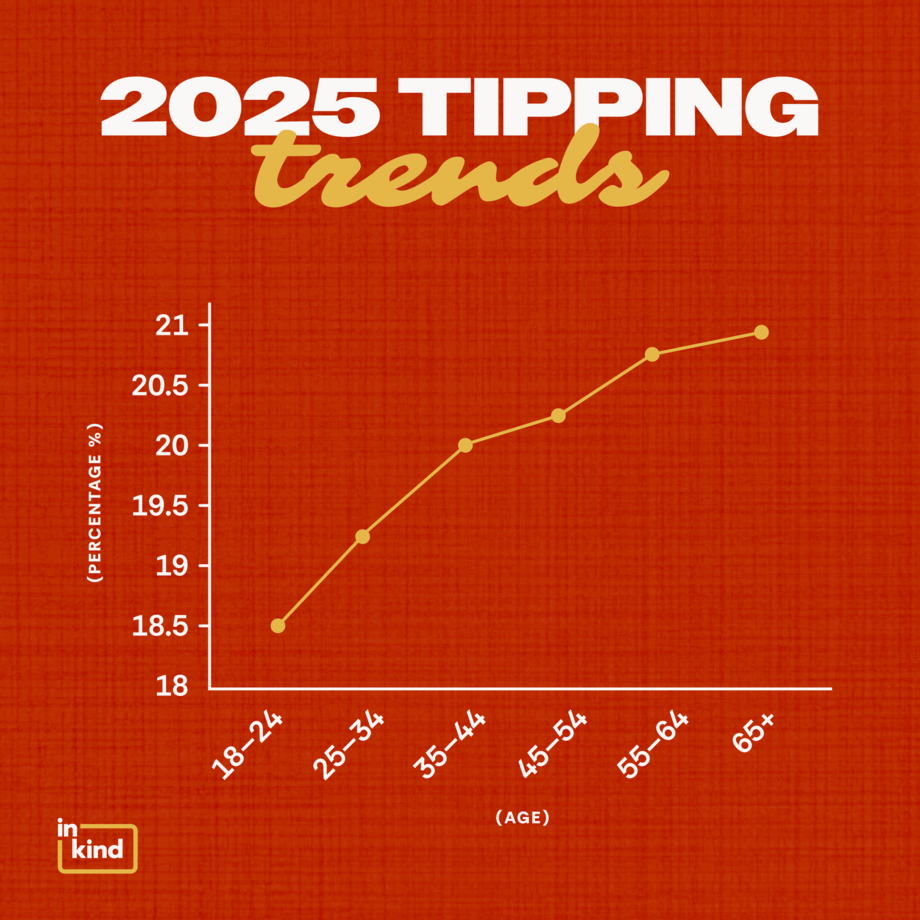
Across fine dining, bars, casual restaurants, fast casual, and coffee shops, the same pattern shows up every time: tip percentage increases steadily with age.
Here’s how it shakes out:
What’s especially notable is how durable this trend is. It’s:
Translation: tipping behavior is increasingly shaped by generational norms, not just service quality or check size.
For restaurant teams, this matters for shift planning, server expectations, and guest mix, especially in venues with younger demographics.
These generational tipping patterns show strong staying power. As younger diners continue to make up a larger share of the dining population, restaurants may need to rethink compensation models, guest education, and expectations around gratuity, especially in tip-reliant formats.
Older diners tip more. Consistently. Everywhere.
Across fine dining, bars, casual restaurants, fast casual, and coffee shops, the same pattern shows up every time: tip percentage increases steadily with age.
Here’s how it shakes out:
- 18–24: ~18.5%
- 25–34: ~19.3%
- 35–44: ~20.0%
- 45–54: ~20.3%
- 55–64: ~20.7%
- 65+: ~20.9%
What’s especially notable is how durable this trend is. It’s:
- stable
- repeatable
- and largely independent of venue type
Translation: tipping behavior is increasingly shaped by generational norms, not just service quality or check size.
For restaurant teams, this matters for shift planning, server expectations, and guest mix, especially in venues with younger demographics.
These generational tipping patterns show strong staying power. As younger diners continue to make up a larger share of the dining population, restaurants may need to rethink compensation models, guest education, and expectations around gratuity, especially in tip-reliant formats.
Menu Trends: Matcha In, Hot Honey Out
Menus in 2025 were a fascinating mix of comfort, subtle luxury, and “we’re done pretending this is a personality.”
What Was Very In
Matcha
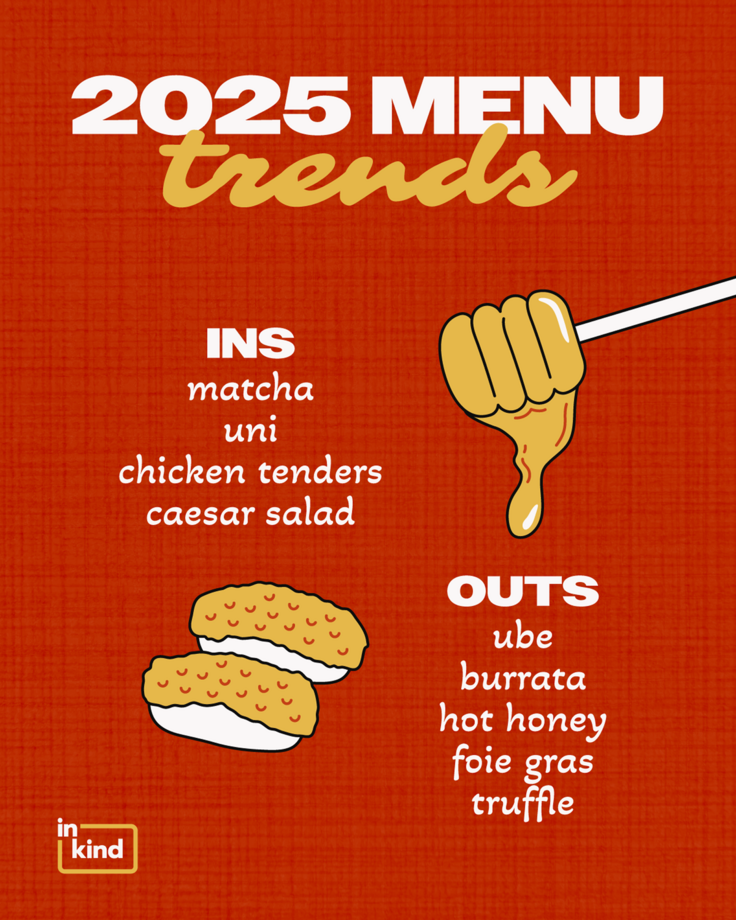
Starbucks reported a 40% increase early in the year, and inKind data shows matcha orders up 32% across cafes and coffee shops. The green wave is real.
Uni
While caviar and truffles cooled off, uni quietly became the luxury ingredient of choice, up 50% year over year and appearing on more menus than ever.
Chicken Tenders & Caesar Salad
No irony here. Tenders were up 15%, Caesar salads up 30%, across everything from bars to fine dining. Nostalgia wins.
What Quietly Faded
For partners, the takeaway isn’t to chase trends. It’s to recognize which items reliably deliver comfort, familiarity, and margin in 2025. Nostalgia is outperforming novelty.
For 2026, expect this pattern to continue. Menus that lean into familiarity, quality, and quiet confidence, rather than viral novelty, are better positioned to meet diners where they are right now.
What Was Very In
Matcha
Starbucks reported a 40% increase early in the year, and inKind data shows matcha orders up 32% across cafes and coffee shops. The green wave is real.
Uni
While caviar and truffles cooled off, uni quietly became the luxury ingredient of choice, up 50% year over year and appearing on more menus than ever.
Chicken Tenders & Caesar Salad
No irony here. Tenders were up 15%, Caesar salads up 30%, across everything from bars to fine dining. Nostalgia wins.
What Quietly Faded
- Ube (−14%)
- Burrata (−20%)
- Hot Honey (−22%)
- Foie Gras (−28%)
- Truffle (−16%)
For partners, the takeaway isn’t to chase trends. It’s to recognize which items reliably deliver comfort, familiarity, and margin in 2025. Nostalgia is outperforming novelty.
For 2026, expect this pattern to continue. Menus that lean into familiarity, quality, and quiet confidence, rather than viral novelty, are better positioned to meet diners where they are right now.
Gifting on inKind: People Are Getting Kinder (Literally)
One of our favorite trends this year has nothing to do with menus.
When people buy gifts on inKind, they can either keep the bonus credit for themselves or send it to someone else.
Here’s what happened:
Even better? Older users (65+) gift at dramatically higher rates, despite being a much smaller share of the user base. When normalized, they gift hundreds of times more often than younger users.
Less “treat yourself.” More “thinking of you.”
For inKind restaurant partners, this shift toward gifting means more first-time guests, more shared discovery, and stronger word-of-mouth, especially among older, high-value diners.
We love to see it.
Gifting is becoming more than a seasonal behavior, it’s turning into a powerful discovery engine.
For restaurants, this means more first-time guests arriving with built-in intent and trust, driven by personal recommendations rather than ads.
When people buy gifts on inKind, they can either keep the bonus credit for themselves or send it to someone else.
Here’s what happened:
- 2023: 75% kept the bonus
- 2024: 50% kept it
- 2025: just 44% kept it
Even better? Older users (65+) gift at dramatically higher rates, despite being a much smaller share of the user base. When normalized, they gift hundreds of times more often than younger users.
Less “treat yourself.” More “thinking of you.”
For inKind restaurant partners, this shift toward gifting means more first-time guests, more shared discovery, and stronger word-of-mouth, especially among older, high-value diners.
We love to see it.
Gifting is becoming more than a seasonal behavior, it’s turning into a powerful discovery engine.
For restaurants, this means more first-time guests arriving with built-in intent and trust, driven by personal recommendations rather than ads.
The Big Takeaway
If 2025 dining had a personality, it would be:
For diners, that means more intentional choices and fewer impulse decisions. For restaurants and partners, it means something even more valuable: a clearer, more predictable guest.
2025 was the year dining behavior stabilized.
2026 is shaping up to be the year operators can finally build with confidence again.
Which, honestly? Still feels kind of luxurious.
- calmer
- more intentional
- slightly nostalgic
- quietly generous
For diners, that means more intentional choices and fewer impulse decisions. For restaurants and partners, it means something even more valuable: a clearer, more predictable guest.
2025 was the year dining behavior stabilized.
2026 is shaping up to be the year operators can finally build with confidence again.
Which, honestly? Still feels kind of luxurious.
About inKind
inKind is the only dining rewards app that gives you 20% BACK every time you dine. Download the inKind app to explore and earn inKind Cash Back at Michelin-starred restaurants, cozy neighborhood coffee shops, and even the hottest nightclubs.
At inKind, we believe restaurants are the heartbeat of a city. That’s why we back them — and reward you for doing the same. Our unique model supports restaurants with funding,
marketing support, and more, so every time you dine with inKind, you’re helping restaurants thrive.
As a thank you for supporting the amazing restaurants in our network, we give you 20% back on your meal. No codes, no points, no catches.
At inKind, we believe restaurants are the heartbeat of a city. That’s why we back them — and reward you for doing the same. Our unique model supports restaurants with funding,
marketing support, and more, so every time you dine with inKind, you’re helping restaurants thrive.
As a thank you for supporting the amazing restaurants in our network, we give you 20% back on your meal. No codes, no points, no catches.